Dev Updates
Dev Stream #1 Recap
Dev Stream #1 Recap:
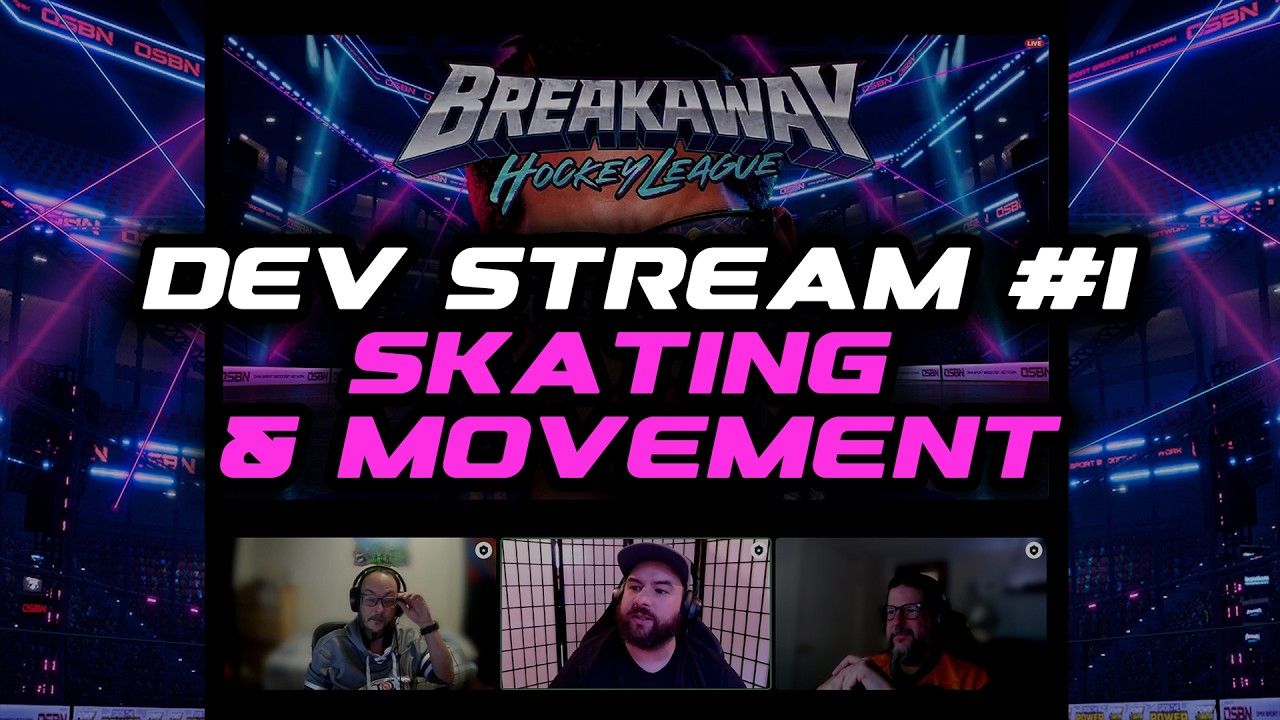
Skating & Movement Reveal
On October 13, we hosted our first-ever Breakaway Hockey League developer stream, giving the community its first look at pre-alpha gameplay.
Joined by Design Director Steve, Sr. Technical Animator David, and Game Designer / Head of Marketing & Community Hugo, we walked through our approach to skating and movement, the philosophy behind our mechanics, and what's coming next.
This also marks the beginning of our new open development approach, where we'll share unfinished gameplay, discuss design decisions, and gather community feedback through developer streams every two weeks.
Why We're Showing Pre-Alpha Gameplay
Breakaway Hockey League is still in pre-alpha, having been in development for roughly six to seven months, including pre-production.
That means the animations, movement speeds, mechanics, and visuals shown during the stream are all subject to change.
Rather than waiting until the game is more polished, we want to bring the community into development earlier. Our goal is to demonstrate how the game evolves, explain the reasoning behind our design decisions, and use feedback to help shape the experience.
Most importantly, we want players to understand what makes Breakaway different.
Our Philosophy: Movement Is a Skill
Skating is the foundation of Breakaway Hockey League.
Our objective isn't to perfectly simulate every aspect of real-world skating. Instead, we're building a movement system that's intuitive to learn but offers significant depth and long-term mechanical mastery.
We're taking inspiration from competitive games like Rocket League and Apex Legends, where movement itself becomes a skill that separates experienced players from beginners.
Every action should have purpose, every movement should have consequences, and players should be rewarded for mastering their controls.
Our guiding principles are:
- Analog over binary: Movement should respond to player input rather than relying on predefined animations or automated actions.
- Momentum matters: Speed, direction, and positioning influence how skaters move around the ice.
- Easy to learn, difficult to master: Players should be able to pick up the controls quickly while continuing to improve over hundreds of hours.
- Skill determines outcomes: Better movement, timing, and decision-making should create opportunities to outplay opponents.
Breaking Down Skating & Movement
1. Forward and Backward Skating
Unlike traditional hockey games, Breakaway doesn't require a dedicated button to transition between forward and backward skating.
Instead, transitions happen naturally based on directional inputs and the player's camera orientation. Players can move into backward skating, pivot to face an approaching opponent, and transition between offensive and defensive positioning without interrupting the flow of movement.
The game uses a third-person camera controlled by the right analog stick. The camera isn't locked behind the skater, allowing players to look around, maintain awareness, and move in directions independent of where they're looking under certain conditions.
This becomes especially important during defensive positioning, where players need to track incoming opponents while maintaining their own movement.
2. Crossovers
Crossovers are a key mechanic for generating speed and moving laterally across the ice. You’ll never lose speed doing a crossover.
By combining directional and camera inputs, players can perform continuous crossovers, building speed until reaching their maximum skating velocity. Players can chain forward and backward crossovers and alternate directions to navigate the ice efficiently.
3. Sprinting and Stamina
Players can sprint to increase their skating speed, but doing so introduces trade-offs.
Sprinting consumes stamina and reduces lateral agility, making it harder to perform sharp directional changes while moving at high speed. Skaters also move slightly faster without the puck than with it, giving defenders an opportunity to close the distance on puck carriers.
These mechanics are designed to make speed management an important part of gameplay rather than allowing players to sprint constantly without consequences.
4. Agile Skating and Carving
One of the more distinctive movement mechanics revealed during the stream was our dedicated agility & carving mode.
Rather than using a traditional dodge animation, Breakaway allows players to enter a more agile skating state, enabling sharper turns and evasive maneuvers.
This opens up opportunities to avoid incoming body checks, create separation from defenders, and change direction rapidly. Importantly, agile skating isn't intended to be an automatic escape mechanic. Properly timed checks and poke checks can still defeat evasive movement.
We're continuing to evaluate how much momentum players should retain during carving and how the mechanic interacts with other skating systems. The goal is to create opportunities for skill expression without introducing an ability that has no meaningful counterplay.
5. Braking and Direction Changes
Breakaway currently features two methods of braking.
Players can slow down by pulling the analog stick against their direction of travel or use a dedicated hockey-stop input to stop more quickly.
We're also prototyping an additional mechanic that would allow players to use the energy from a hockey stop to accelerate rapidly in a new direction. This could introduce additional combinations between braking, carving, and acceleration, further expanding the movement system's mechanical depth.
6. One-on-One Skating
We demonstrated several situations involving attackers and defenders transitioning between offensive and defensive movement. These scenarios highlight the importance of skating angles, positioning, momentum, and timing.
Because puck carriers are slightly slower than players without the puck, defenders can close gaps. However, attackers can use their movement options to evade pressure, maintain possession, or create passing opportunities. We're designing these interactions around counterplay, where different movement and defensive actions have strengths, weaknesses, and consequences.
Testing Mechanical Mastery
During early development, we created a series of timed skating challenges to evaluate the movement system.
These include courses featuring increasingly tight turns, precise stopping zones, long sprints, stamina management, and combinations of sweeping and sharp turns. The purpose is to determine whether players can meaningfully improve at skating through practice. Simply moving around an empty rink doesn't always reveal the strengths or weaknesses of a movement system.
By introducing objectives, measurable times, and opportunities for optimization, we can better identify areas that need improvement. These tests have already demonstrated opportunities for players to optimize their routes, improve their precision, and develop greater mechanical control.
Additional Gameplay Details From the Live Q&A
While skating was the focus, we also answered several questions about the broader game.
Camera and aiming: Breakaway uses a third-person camera with a reticle-based aiming system. Players will have direct control over where they're looking and aiming, rather than relying on automated targeting. Field-of-view customization is also being considered.
Controls: Gamepad is our primary development focus because analog sticks support the level of control we're aiming for. Keyboard controls are already playable, while full mouse support remains under investigation, particularly for mechanics involving analog passing and tipping.
Player-controlled goalies: Goalies are fully human-controlled. Positions are fluid during matches, meaning players can rotate responsibilities, including taking over the net when their goalie leaves it.
Player archetypes: We're exploring different player body types with potentially minor differences in physical characteristics, similar to vehicle hitboxes in Rocket League. However, our intention is to maintain a level competitive playing field. Players won't gain advantages through traditional shooting or passing skill ratings.
Match structure: The core experience is built around five-minute matches. We're prioritizing a concentrated matchmaking population early in development, with potential additional modes and customization options considered for the future.
Customization: Character, equipment, stick, club, and arena customization are all areas we're interested in exploring. Our immediate priority, however, is getting the core gameplay right before expanding these systems.
Platform support: Development is currently PC-focused, allowing our small team to iterate quickly without the additional certification and maintenance requirements of console releases.
What's Next for Skating?
Our movement system is already playable and being tested internally every week, but there's still plenty of work ahead.
We'll continue refining skating speed, acceleration, momentum, turn rates, animation transitions, and the interactions between different movement mechanics.
We're particularly interested in exploring combinations of abilities, such as transitioning from a hockey stop into an agile turn or finding new ways for players to preserve and redirect momentum.
As development progresses, community feedback will help us understand which mechanics feel intuitive, which require adjustment, and where opportunities for greater skill expression exist.
Our ultimate goal remains the same: build a skating system that's fun from the first match but continues rewarding mastery long after.
Playtests and Future Dev Streams
We also confirmed that our first community playtests are planned for 2026, with more information about timing and access to come in future updates. These will be pre-release playtests, not the Early Access launch.
We'll continue hosting developer streams every two weeks, each focusing on different aspects of Breakaway Hockey League. Future topics will explore more of the systems that make up the complete hockey experience, including mechanics not covered in our first skating reveal.
Thank you to everyone who joined our first stream, shared feedback, and helped make this new approach to development possible.
We're excited to keep building Breakaway Hockey League with you.
Wishlist on Steam: https://bhl.game/steam
Sign up for playtests: https://bhl.game/playtest
Join our Discord: https://bhl.game/discord