Dev Updates
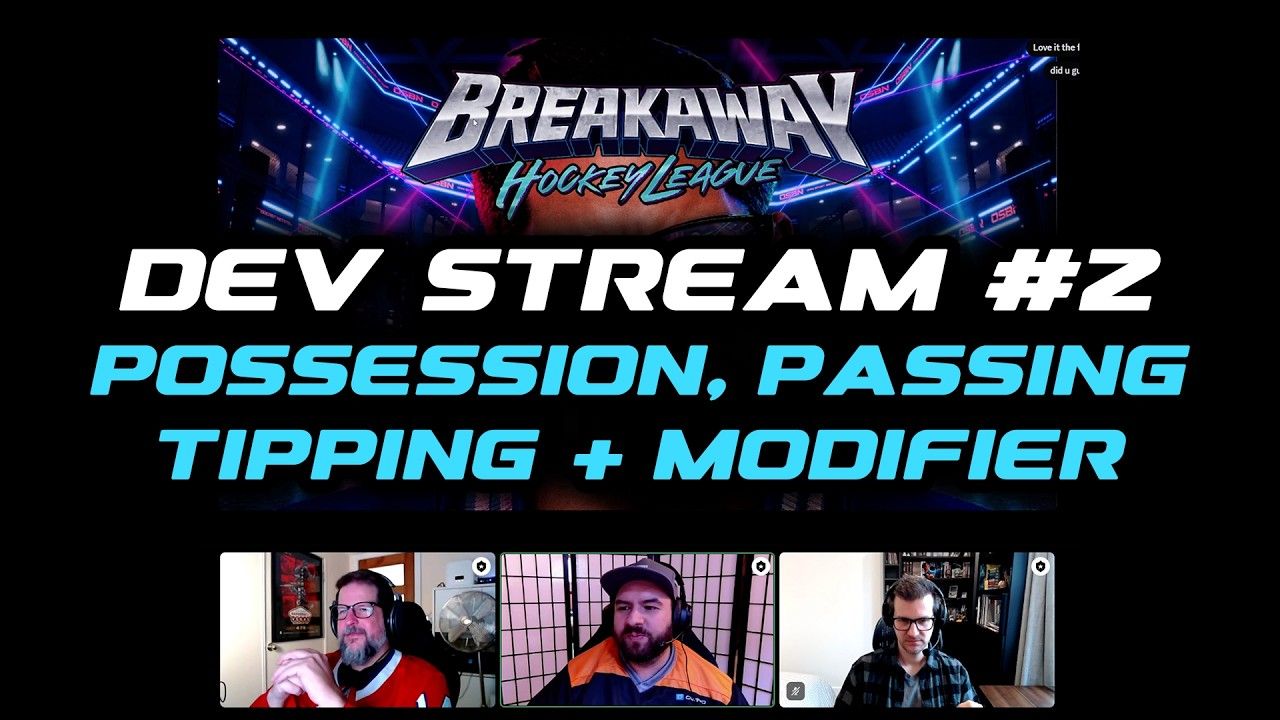
Dev Stream #2 Recap
Dev Stream #2 Recap: Puck Possession, Passing & Tipping Reveals
Our second Dev Stream is officially in the books!
This time, we were joined by Steve, Hugo and Technical Design Director Marco to take a closer look at how we're handling puck possession, passing, saucer passes, one-touch plays, and one of our favourite mechanics so far: tipping.
If you missed the stream, or just want the highlights without listening to us talk for over an hour, here's what we revealed, what we're still figuring out, and a few things we learned along the way.
And yes, we're still in pre-alpha. It's been two weeks, not two years.
1. Puck Possession: No Magical Puck Vacuums
One of our biggest design goals for Breakaway is making sure that what happens on the ice feels earned. That starts with something seemingly simple: picking up the puck. Rather than having the puck automatically snap to your player whenever you're nearby, we've built a possession system that prioritizes the actual position of your stick.
Here's how it currently works:
- Your stick is your primary possession zone. Moving your stick to your forehand or backhand changes where you can collect the puck.
- Your skates act as a secondary zone. This helps with pucks that come closer to your body and allows you to kick the puck up to your stick.
- Puck speed and height matter. A puck travelling too quickly or too high won't magically become yours just because you're standing nearby.
- Positioning matters. You can deliberately intercept passes, collect pucks off the boards, or allow them to travel past you by moving your stick out of the way.
We actually prototyped a version where you had to press a button to take possession. It was terrible.
The challenge has been finding the balance between making possession accessible to new players and rewarding those who learn to use their stick more deliberately. We're getting closer, but there's still work to do. For example, we're seeing too many passes being received by the skates instead of cleanly on the stick.
Developer insight: One of the benefits of this approach is that interceptions and puck recoveries become intentional plays rather than the result of invisible assistance. That same philosophy carries into passing and tipping.
2. Passing: Easy to Learn, Plenty to Master
Next up was passing, where we revealed two different approaches designed to work together.
Basic Passing
We want players to jump into their first match and actually play hockey, not spend their first three hours figuring out how to complete a pass. Basic passing is designed to make that possible.
A quick tap of the pass button sends the puck toward your selected teammate, with assistance to help lead the pass based on their movement. You still need to aim toward the teammate you want. The game simply helps handle the execution.
This creates a much more natural game flow, particularly for newer players. But there's a trade-off. The system decides where to lead the pass and how much power to use.
And as anyone who's played hockey knows, sometimes the pass you want to make isn't where your teammate is going. Sometimes it's where you want them to go. That's where things get interesting.
Advanced Passing: Full 360° Control
Holding the pass button activates advanced passing, giving you manual control over the direction, placement, and strength of your pass. Unlike basic passing, there's no automatic targeting. You decide where the puck goes.
That opens the door to some pretty interesting possibilities:
- Lead teammates into open space, rather than directly targeting them.
- Send stretch passes with more power.
- Bank passes off the boards, including passes to yourself.
- Execute drop passes and backwards passes.
- Put the puck into space for a teammate to skate onto.
Holding the pass button currently puts your player into a glide while you aim, allowing you to maintain momentum as you prepare the pass. We're also experimenting with alternative ways to control passing strength, including a charge-based system.
Developer insight: Automatic passing has limitations, particularly when a teammate suddenly changes direction. Manual passing lets you anticipate the play instead of relying on the game to predict it. The intention isn't to make basic passing bad. It's to make advanced passing capable of things basic passing simply can't do.
3. The Modifier Button: Introducing Saucer Passes
We also gave our first proper look at the modifier button, which will be a pretty significant part of Breakaway's control scheme. Currently mapped to the right shoulder button, the modifier changes the behaviour of other inputs.
For passing, that means saucer passes.
The best part? It works with both basic and advanced passing. You can throw an assisted saucer to a teammate or manually place an aerial pass into space using the advanced system.
This adds another layer to playmaking, especially when trying to move the puck past defenders or create opportunities that aren't available along the ice. Now, we should probably address something. Our saucer passes are currently flying a little higher than we'd like. Less saucer, more unidentified flying object.
We're working on refining their height, distance, and speed while making sure players can clearly distinguish an aerial pass from one travelling along the ice. That last part matters quite a bit with a third-person camera. And the modifier won't stop at passing. We've designed it to work with other mechanics too, which we'll get into in future streams.
4. One-Touch Passing: Keep That Puck Moving
This was one of the more exciting systems we demonstrated. By holding the advanced passing input before receiving the puck, players can immediately redirect it into another pass without first taking possession. And because this uses our manual passing system, you're in control of where that next pass goes.
That means you can chain together quick passing sequences, redirect the puck across the ice, play it off the boards, or make a one-touch drop pass. You can even combine the modifier with one-touch passing to immediately redirect the puck into a saucer pass.
In one of our gameplay examples, we managed to thread a one-touch pass directly between two defenders. It's the kind of play that feels fantastic when you pull it off, especially because the game isn't doing it for you.
Developer insight: Our limited puck vacuum plays an important role here. If every nearby defender automatically collected the puck, many of these precise passing sequences wouldn't be possible. We're intentionally creating room for players to develop the timing, positioning, and control needed to execute these plays. And speaking from experience, that takes practice.
5. Tipping: You Control the Deflection
This might be our favourite reveal from the stream. In Breakaway, tipping isn't a random chance determined by a player's attributes. You aim the tip. You position the stick. You decide where the puck goes. By holding the pass input before the puck arrives, you can prepare a deflection and manually aim its direction.
Here's what we demonstrated:
- Redirecting shots toward different areas of the net.
- Tipping pucks along the ice, at knee height, or higher.
- Using the modifier to lift a deflection into the air.
- Moving the stick to the forehand or backhand to meet the incoming puck.
- Deflecting pucks while moving, including between-the-legs tips.
Your stick actually needs to be in position to make contact. If the puck is travelling toward your backhand and your stick is sitting on your forehand, you're probably going to miss. There's no automatic animation to save you. We also demonstrated how you can combine manual saucer passes, directional passing, and tipping to create plays entirely under player control.
For example, you could lead a moving teammate with an aerial pass that they redirect toward the net without ever taking possession. That's the kind of skill expression we want to build Breakaway around. Of course, we're still adjusting tipping speeds, heights, and animations. Some of our current deflections are coming off the stick with a little too much enthusiasm. But the foundation is already a lot of fun.
6. How Far Can These Mechanics Go?
We ended the gameplay portion by experimenting with some pretty ridiculous combinations.
Could you theoretically chain multiple aerial passes between teammates without letting the puck touch the ice, then bat it into the net? Yes. Can we reliably do it ourselves? Absolutely not.
We even used an internal development tool to demonstrate some of the possibilities because pulling these plays off with actual teammates is incredibly difficult. And that's kind of the point.
We're not trying to build a game where everyone needs to master complicated mechanics just to have fun. We're building a game where you can enjoy yourself almost immediately, but still discover new ways to improve hundreds of hours later.
Much like Rocket League, we expect players to eventually discover combinations and techniques we haven't even considered. We're very much looking forward to seeing what happens when people significantly better than us get their hands on the game. Probably a little concerned, too.
7. Community Q&A: A Few More Things We Revealed
We covered quite a bit during the Q&A, including some details beyond possession and passing.
Q: How did the first multiplayer test go?
Pretty well! We recently held a small friends-and-family test with approximately 25 participants, earning an average appreciation score of 8.8/10. We were especially encouraged to see players organizing positionally, cycling the puck, and putting together passing plays. We also discovered some server performance issues, which our technical team managed to address during the test. That's why we test things!
Q: Will Breakaway have skill-based matchmaking?
Yes! Skill-based matchmaking is planned from the start.
We want experienced players to have plenty of room to master difficult mechanics, without making the game miserable for someone playing their first match.
Q: Will Breakaway support mouse and keyboard?
Yes. Controller is currently our primary input method, but we're actively developing mouse and keyboard support. One of the bigger challenges is translating our manual passing system to mouse controls. We're already prototyping solutions and testing them internally.
Q: How will players keep track of the puck and incoming passes?
We've developed several visual indicators to help players track the action, including a puck-following spotlight, a trail, and an outline visible at distance. For incoming passes, we're also experimenting with trajectory indicators that show where the puck is predicted to arrive. Turns out tracking a tiny black disc travelling across an ice rink at high speed presents a few challenges.
Q: Will players be forced to play goalie?
Currently, players rotate positions after goals, including the goalie position. We're exploring options that could allow players to opt into or out of playing goalie, but nothing is finalized yet.
Q: Will fighting be in Breakaway?
We want it to be! Fighting is something we'd like to add, but right now our priority is getting the core hockey experience where we want it. We should probably make sure everyone can pass the puck before we let them punch each other.
Q: Will Breakaway have player attributes, stat upgrades, or pay-to-win mechanics?
No. We're not interested in making players grind for better skating, stronger shots, or equipment that provides gameplay advantages. Our philosophy is simple: your ability on the ice should come from your ability as a player.
Q: What about progression, customization, and other game modes?
Our initial focus is on building a strong competitive hockey experience, with ranked play at its core. Progression, customization, and additional systems are things we'll continue exploring as development progresses, but we want to get the hockey right first.
8. What's Next?
A lot of the systems we revealed are already playable, but they're far from finished. Our immediate focus includes refining puck possession zones, improving passing power and distance controls, tuning saucer pass trajectories, and making tipping and one-touch interactions more consistent.
We're also continuing to test how these mechanics work together, because that's where some of the most interesting gameplay is starting to emerge. And that brings us to the most important part.
Our first public playtest is still planned for 2026.
We don't have dates to share just yet, but you can sign up now to be considered for access.
Join the Playtest: https://breakaway.firstlook.gg
Wishlist on Steam: https://bhl.game/steam
Wishlist on Discord: https://bhl.game/discord
We also introduced Golden Tickets during this stream, giving five viewers guaranteed access to our first playtest. We'll be looking for more opportunities to reward the people supporting us this early. And finally, a huge thank you to everyone who joined us, asked questions, shared feedback, and watched us attempt to play hockey both virtually and, unfortunately for some of us, in real life.
We're showing Breakaway this early because we want you involved in how it develops. That means showing the mechanics we're excited about, the things we're still figuring out, and occasionally something that looks completely ridiculous.
We'll share details about Dev Stream #3 soon.
See you on the ice.